

The Matter protocol is a universal, IP-based connectivity standard developed by the Connectivity Standards Alliance (CSA). It uses local IP addresses to allow devices from different manufacturers to communicate without proprietary gateways. When configuring a smart home, users sometimes encounter network errors during the transition to this new standard. These errors usually result from local router configurations or hardware memory management, rather than the standard itself. iNELS engineers its hardware to resolve these specific technical errors at the component level.
1. Connection timeouts and setup failures
“A user scans the setup QR code, the application shows a “Connecting” screen, and the process times out. The connection fails, requiring multiple hardware resets to add one device.”
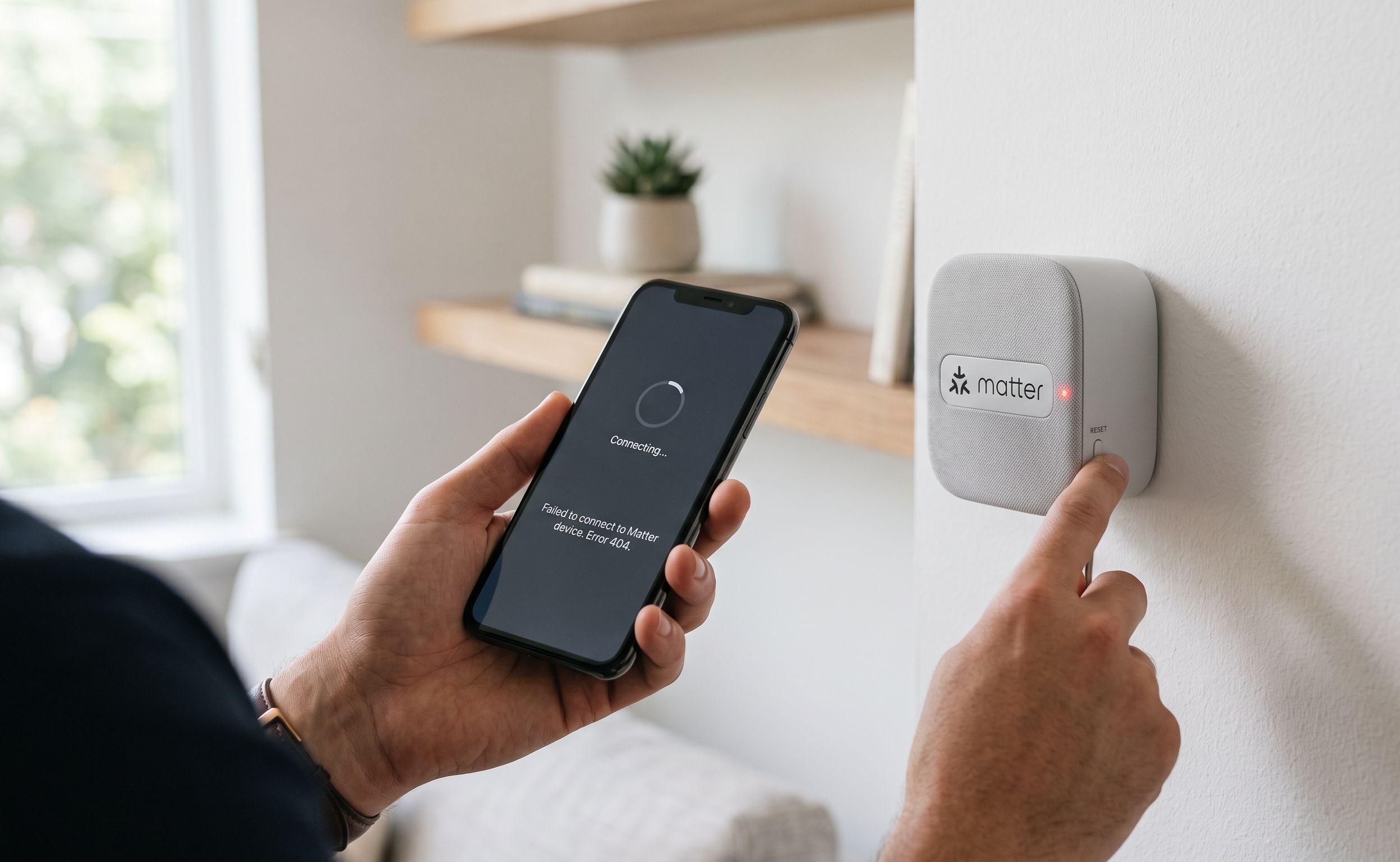
Devices communicate locally using IP addresses. During the setup phase, the smartphone, the Thread Border Router, and the new device execute a secure connection process using the IPv6 protocol and mDNS (Multicast DNS). If a Wi-Fi router blocks mDNS traffic or isolates the 2.4 GHz and 5 GHz bands, this connection drops.
Every iNELS device contains a hardcoded Device Attestation Certificate (DAC). When a user scans the QR code to add a smart relay to Apple Home or Samsung SmartThings, the internal processor broadcasts these credentials using AES-128 encryption. This hardware handles the cryptographic exchange directly, allowing the network to verify the device in approximately 5 seconds, provided the local router supports standard mDNS traffic.
2. Delayed network synchronization
“A device fails to connect initially but synchronizes with the system several days later without any network modifications.”
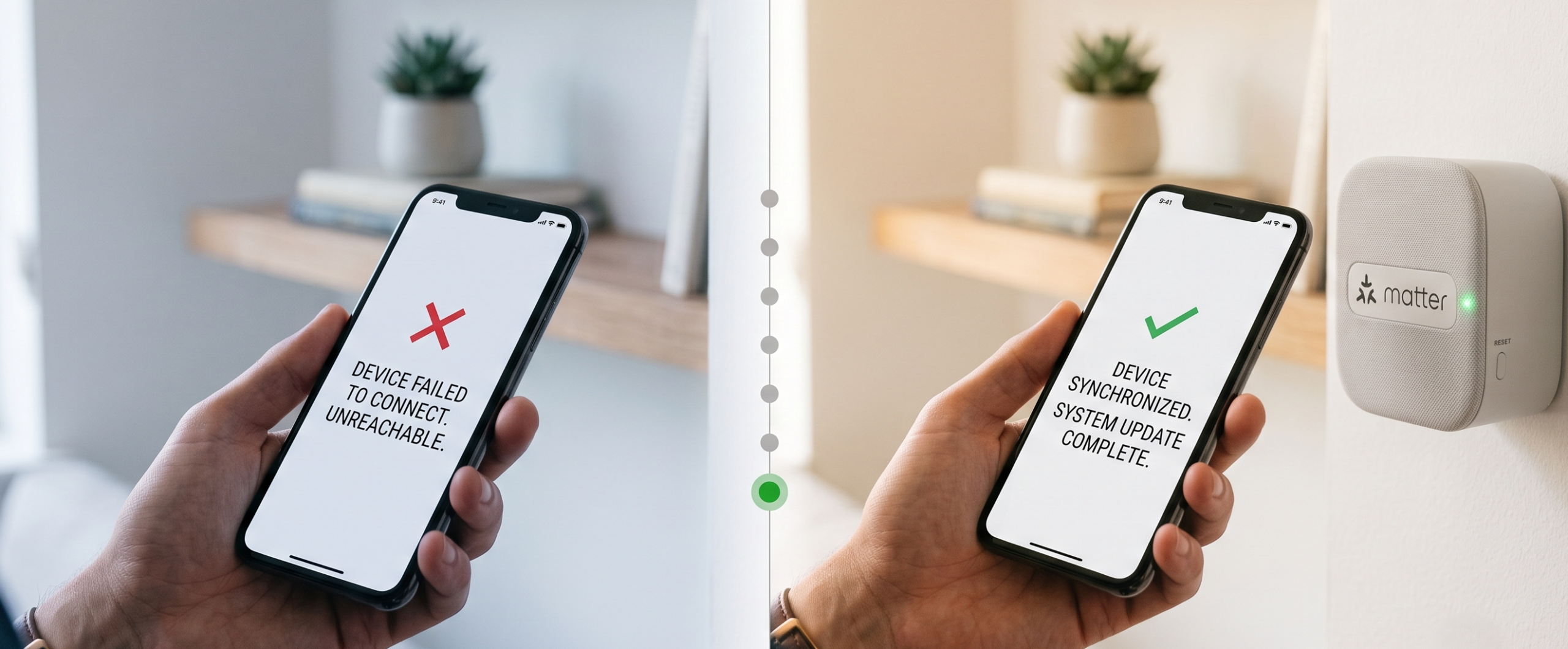
Thread operates as a self-healing mesh network. When a new endpoint joins, it calculates the routing path to the Border Router. Devices with weak internal antennas force the network to spend hours or days reconfiguring its routing tables to establish a stable connection for that specific node.
iNELS actuators and sensors use internal antennas specifically designed for the 2.4 GHz spectrum instead of standard, low-power communication chips. Upon activation, they establish a direct routing path immediately. This hardware design allows the device to connect to the local network structure without forcing the system to recalculate existing routing tables.
3. Signal drops in Wi-Fi networks
“Smart devices periodically drop offline even when connected to a Wi-Fi mesh system with dedicated channels.”
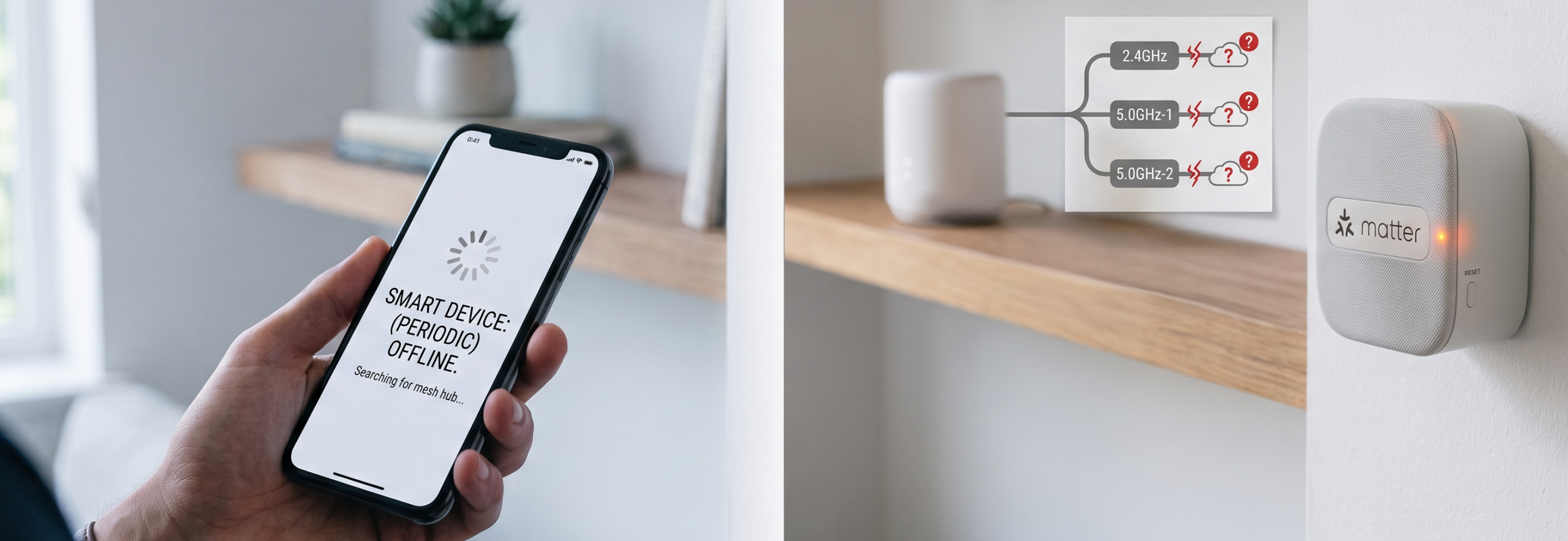
The 2.4 GHz Wi-Fi spectrum accommodates microwaves, Bluetooth devices, and neighboring networks. High traffic density leads to packet collisions. When multiple smart devices send connection requests simultaneously, standard routers drop packets, causing devices to go offline.
iNELS devices bypass Wi-Fi transport by utilizing Thread as the wireless transport layer. The RFSAI-62B-SL/MT in-wall relays and RFDEL-71B-SL/MT smart dimmers function as active routing nodes within the Thread mesh. They pass data packets directly to each other. This localized routing structure keeps the automation traffic off the primary Wi-Fi router, preventing packet loss.
4. Execution delays and cloud latency
“A motion sensor detects movement, but the lights take five to six seconds to turn on.”

Latency occurs when a device relies on cloud APIs. A sensor transmits data to a remote manufacturer server, which forwards the payload to a third-party platform server before returning the command to the local light bulb.
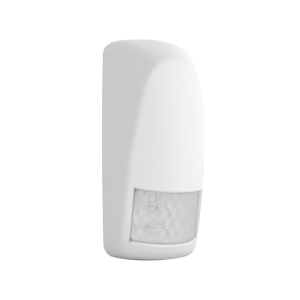
The primary function of Matter technology is local execution. iNELS hardware processes commands locally. For users running a home assistant Matter integration, the system communicates with the hardware directly via local APIs. When an iNELS RFMD-200/MT motion sensor detects thermal movement, it transmits the state change directly across the Thread mesh to the target relay. The signal stays within the local network, maintaining execution times under 200 milliseconds even during an internet service outage.
5. Memory loss during battery replacement
“Replacing a battery in a wireless sensor deletes it from the ecosystem, requiring a system reset and the manual reconfiguration of all scenes.”
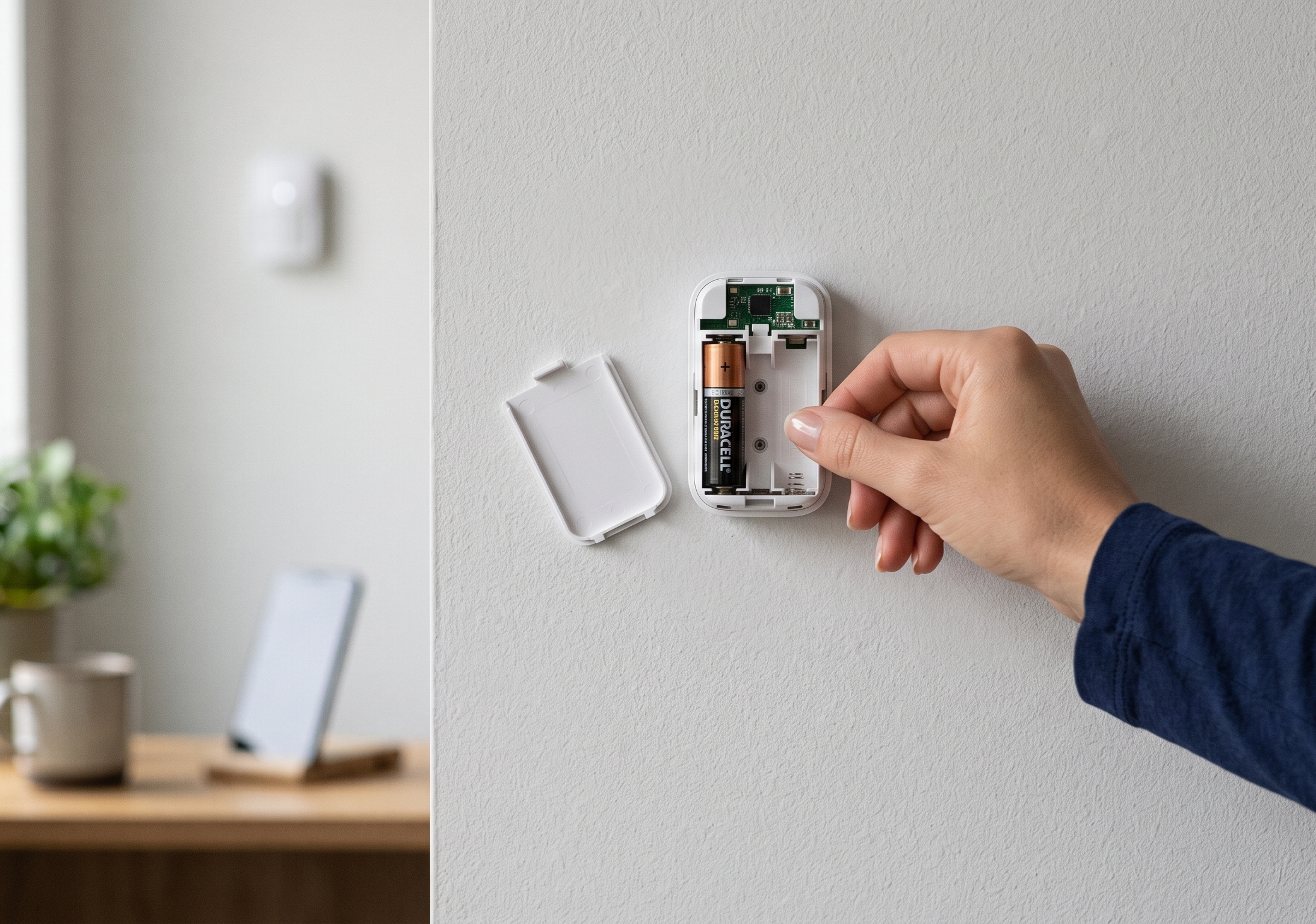
Battery-powered sensors are categorized as Sleeping End Devices (SEDs) and power down their radios to save energy. Removing the battery causes an abrupt loss of power. If the hardware uses volatile memory, it resets its network sequence. Platforms like Amazon Alexa or Apple Home register this sequence mismatch as a security risk and drop the device.
The iNELS RFWD-100/MT magnetic door sensor stores its network credentials, network identities, and security keys in non-volatile EEPROM memory. When a battery is replaced, the device retrieves its stored sequence and sends a wake-up packet directly to the Border Router. The network validates the sequence immediately. (Compatibility note: The current iNELS firmware supports Apple Home, Amazon Alexa, Tuya, Home Assistant, Homey, and Samsung SmartThings. Google Home is currently not supported by this firmware version).
Why physical hardware determines network stability
A software protocol like the Matter protocol relies entirely on the physical hardware running it. Many network errors occur because manufacturers pair modern smart home software with cheap, low-grade physical components. A relay that burns out or a wire terminal that loses its grip will lose power. When this happens, the device drops offline, breaking the Thread network mesh and causing the exact connection errors detailed above.
iNELS prevents these physical failures by using industrial-grade components to support the software. Manufactured at the ELKO EP plant in the Czech Republic, the hardware is designed specifically to maintain long-term network uptime.
Zero-Cross switching for hardware longevity
Standard smart relays often fail because of electrical arcing. When turning on modern LED drivers, a surge of electricity can melt the physical contacts inside the relay, destroying the device and disconnecting it from the system. The iNELS hardware prevents this using Zero-Cross switching technology. The processor times the mechanical switch to close exactly when the alternating current (AC) crosses zero volts. This eliminates electrical arcing, allowing the relay to remain operational and online within the Thread mesh for millions of cycles.
Stable power via Push-In terminals
Loose electrical wires cause micro-power fluctuations. These fluctuations force smart devices to constantly reboot, dropping them from the network. iNELS units replace traditional screws with screwless push-in terminals. These maintain a constant spring-loaded clamping force on solid or ferruled copper wires. This prevents wire degradation caused by temperature changes over time, guaranteeing the device receives stable power to keep its network connection active.
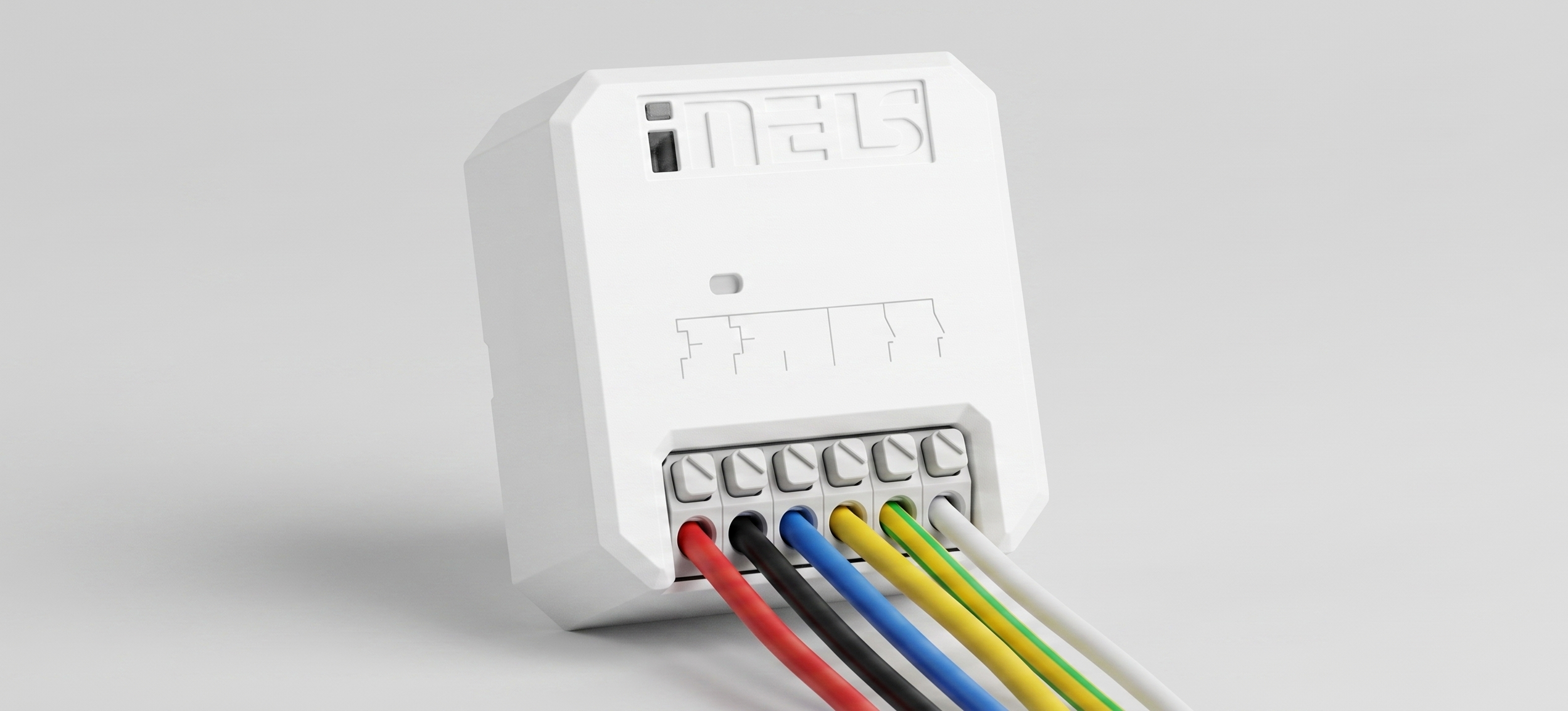
The iNELS Lineup for local installations
By combining these physical safeguards with Matter technology, the iNELS lineup provides a stable foundation for any automated environment.
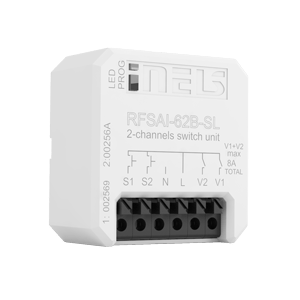
- Flush-Mounted Actuators: The RFSAI-62B-SL/MT in-wall smart relay mounts behind existing light switches in standard European KU-68 boxes. Following a power outage, iNELS relays default to the OFF state to prevent unmonitored appliances from creating fire hazards. The RFDEL-71B-SL/MT smart dimmer utilizes internal state-retention memory to restore the exact previous brightness value, instantly reconnecting to the Thread network upon power restoration.
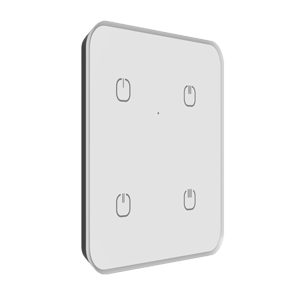
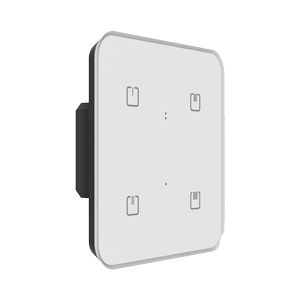
- Wireless Controllers: The RFGB series operates directly on the Thread network using battery power. The hardware consists of a flat glass surface with four capacitive touch buttons. Users mount the panel using double-sided adhesive tape. It functions as a local scene controller to operate multiple relays simultaneously.
- Environmental Sensors: The iNELS RFMD-200/MT motion sensor detects infrared thermal movement. The RFWD-100/MT magnetic contacts use a physical reed switch to monitor doors and windows, reporting the physical state directly to the network fabric.
System integration and purchasing
A professional smart home requires physical hardware that outlasts software updates. The manufacturer provides a 5-year warranty for these components to guarantee long-term stability. Users and professional installers planning a localized electrical installation can buy the required relays, dimmers, and sensors through the iNELS catalog to construct a stable, error-free automated environment.